

The voices of Private Security…
 Interview with Mr. Rene Pasculescu, General Manager and shareholder of the Civitas Group of Companies,
Member of the 2018 OSPA Jury
by Gabriel Badea
Although it is a relatively young field of activity, the security industry in Romania already has its personalities, people who have made their mark within the guild and in society through education, professional achievements and business success.
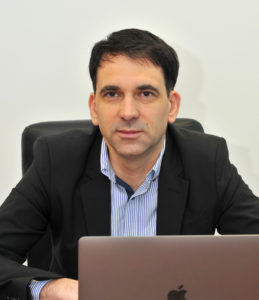 About Rene Pasculescu, General Manager and shareholder of the Civitas Group of Companies, one of the most important national solution providers and integrator of security and life protection systems, it can be said that he is indeed such a personality, a “Voice” (capitalized) of the Romanian security industry, a serious voice, recognized and confirmed at the highest level of professional and managerial excellence.
About Rene Pasculescu, General Manager and shareholder of the Civitas Group of Companies, one of the most important national solution providers and integrator of security and life protection systems, it can be said that he is indeed such a personality, a “Voice” (capitalized) of the Romanian security industry, a serious voice, recognized and confirmed at the highest level of professional and managerial excellence.
First of all, managerial skills are those that can make the “difference”, in an environment characterized by fierce competition, such as security and in this regard Mr. Pasculescu has been concerned with acquiring the most advanced concepts and strategies in business administration by following a prestigious master’s program (MBA) offered by the Open University in the UK.
Specializing in private security was also one of his priorities. Thus, after following a series of programs offered by ASIS International, the most important professional organization in the field of security worldwide, Mr. Pasculescu was awarded the title of Certified Protection Professional (CPP), one of the most important forms of recognition of professional competence and capacity in the field of private security internationally.
But his effort of self-improvement and professional development has not stopped yet. And currently, Rene Pasculescu is a “full-time” student attending a master’s program in security at the prestigious British University in Portsmouth.
Obviously, this almost ideal combination of experience, expertise and extensive skills was reflected in its performance in the profession and in business. Civitas Group of Companies skilfully led by Mr. Pasculescu consistently ranks each year among the top most successful businesses in the field of private security, competing on an equal footing with multinationals in this sector.
At the same time, Rene Pasculescu plays an active and important role in the professional organizations of the industry and specially makes a consistent contribution to their campaigns, programs and initiatives dedicated to improving business conditions in the field of private security, on the line of combating unfair competition and improving the legal regulatory framework of this sector.
Thus, Rene Pasculescu became a member of the Boards of the Romanian Association for Security Industry and the Federation of Security Services and since the beginning of this year, he is the President of ASIS International – Romania Section (ASIS – Chapter Romania), which brings together managers and security professionals representing both the corporate environment and the public sector.
Furthermore, Mr. Rene Pasculescu is also part of the group of personalities invited to judge the OSPA in Romania.
Moreover, Rene Pasculescu was kind enough to give us an interview during which we learned new and interesting details about his concerns both as president of ASIS International, but also as an old and experienced member of the private security business community.
Issues of the Security Industry
The Voice of Private Security (VSP): What would you think are the 3 big problems the Romanian security industry is currently facing? (please argue, especially from the perspective of President of ASIS CHAPTER ROMANIA)
Rene Pasculescu (RP): If we talk about the electronic security systems sector, I think the biggest problem is the lack of qualified personnel. In Romania, unfortunately, there are no undergraduate or postgraduate courses specialized in security technology, the only trainings and programs being those organized by the professional association and very few professional training providers. These are not enough and this results in a very long training cycle of a technician or security systems engineer.
If we switch to the security sector, we primarily face the very low quality of the services provided. Here the biggest problem is related to customer requirements and expectations. In very few cases, they know how to appreciate a service provided with high quality standards. Most are satisfied with a poor-quality service, which they often contract only from the perspective of legislative compliance.
So the customers are the ones who could impose a higher quality level of security services by increasing the quality requirement, which is not yet happening.
It is obvious that low security budgets are also an obstacle. The constant pressure on cost reduction determines the compromise with quality. It is sad that in many cases, in the frenzy of cost reduction, even reputable multinational companies “forget” their own standards of business ethics, which they even proudly display, accepting suppliers that they know do not comply with labour legislation and evade, just because they are “cheap”.
Or how can you advertise yourself as a multinational company that follows an ethical code of good business conduct when you knowingly contract security service providers who do not respect their legal obligations towards their employees?!
And it’s not just labour law. Private security is an area regulated by a special law that imposes from the outset a certain level of quality, precisely to ensure sufficient protection for the beneficiaries of these services. And in this regard, we are talking about legal obligations that are violated, regarding the verification of the persons who want to engage in this field, that “background screening” at employment, we are talking about continuous professional training and control operations, which are, if any, done only on paper….
An important factor contributing to this unfortunate situation is also the fact that in many cases these companies do not have a dedicated and competent security manager to make a selection based on the quality and not just the price of the security provider and to follow the contract to the end.
We know well that there are companies where the security manager position is held by other persons less competent in this field, such as the human resources manager, the administrative manager or the IT manager. Or security has a specific area of knowledge and skills, which you cannot acquire “by ear” or by “part-time learning”…
The third problem that affects the entire security industry, but is much more obvious in the field of security, is unfair competition, based on unsustainable prices, so-called “ruinous prices”, unpaid work in accordance with the labour code, non-taxed and services delivered only “on paper”.
And in the case of electronic systems, we are talking about a form of unfair competition. For example, there are tenders in which the tender specifications require certain parameters that equipment and solutions should meet, then you see that these tenders are awarded at prices below the published budget so that in the end you can see that the winning bid did not meet even half of the original specifications. And yet, those non-compliant bids are accepted on price criteria, that is, the famous principle of awarding public auctions “the lowest price”. Such strange approaches are to the detriment of serious competitors who have even thought and made efforts to present a 100% compliant solution and which is rejected and even to the detriment of those who purchase such systems who prefer to buy apparently cheap services and equipment, but which in fact are ineffective and inefficient. It’s practically money thrown out the window…
After all, all three of these problems are related to the recognition of the importance of the security industry, which is not perceived at a level appropriate to its social and economic impact. There is also no awareness of the negative impact that an improperly performed service or a security solution that does not work may have on the safety of life, property and the environment.
ASIS Romania
VSP: What is the activity of ASIS CHAPTER ROMANIA and what are your priorities as president?
RP: The activity of ASIS is related precisely to the aspects I have already mentioned. It must be said that such problems are not only in Romania, but to a lesser or greater extent they are also present in other countries, including the most developed ones.
That is why ASIS International is concerned to promote quality and professionalism in this field, that is, to respond to these problems of the industry in general.
How does it do it? By developing standards and guidelines for security managers or for the provision of services, by organizing courses from which certifications with international recognition can be obtained, such as CPP, PSP and PCI, by organizing conferences that address various topical topics and by exchanging experience between professionals on various networking opportunities.
ASIS Romania aims for the next three years to increase the public exposure of the chapter and to be as present as possible in security-related events, so as to attract as many professionals from our industry, both from customers and suppliers.
At the moment we are about 50 members, but in the next three years we hope to increase this number and especially to increase the number of those who actively participate in the networking meetings conducted by our chapter, some of these meetings being held even in locations where innovative security solutions have been implemented.
VSP: What is ASIS’s involvement in OSPA?
RP: ASIS will be a partner in the OSPA 2018, already a reference event in the Romanian security industry, and the members of the chapter will participate in the panels organized at the conference and will present innovative security solutions at the exhibition organized during the event.
I am convinced that the presence of ASIS in the events occasioned by the Private Security Day in Romania will bring added value, so that it will consolidate as the most important event in the security industry, being, in fact, the only event that brings together electronic security systems, human security and cyber security, consultants, customers and suppliers, that is, the entire spectrum of private security.
VSP: How useful do you consider this program to recognize professional achievements in the field of private security.
RP: Very useful… from several perspectives.
First of all, we must consider those professionals of our industry who perform at the highest level and whose performances often remain unknown and unrecognized, although they are no less than their colleagues from other countries and who are better promoted. Moreover, for example, there were solutions developed by internationally awarded Romanian specialists, and these true performers were very little known in the country.
It is our duty, the duty those that work in this field, to promote those of us who have such outstanding achievements.
It is also important for us as an industry to send a message of trust to customers, to the general public, in the sense that they know that the security industry is also capable of exceptional quality performance and can rely on the services and equipment delivered by us.
Last but not least, it is about creating an environment that stimulates performance in our field. The fact that there is such a mechanism for recognizing exceptional professional achievements, the fact that a number of professionals have already received this recognition is likely to encourage others to try to achieve such performances, to self-improve, to develop professionally.
VSP: What would you do as a judge if you had to assess a colleague from your own company?
RP: The OSPA regulation is very clear in this regard. The member of the Jury who is in a professional or personal relationship with one or more of the applicants must declare this and abstain from judging. Anyway it is a matter of personal ethics and even common sense I would say…
VSP: What were the 3 most important elements of contributing to the success of the OSPA programme in Romania that you noticed from your membership in the jury?
RP: A first factor would be this international dimension. The fact that this program runs simultaneously in Romania and in important countries such as the United Kingdom, the United States, Germany, Australia, Norway means more weight and seriousness. The fact that the Federation of Security Services managed to bring this program to Romania is a great achievement.
Then the independence and objectivity of evaluating applications must also be highlighted. The fact that applications pass through two filters, one in the UK and one in Romania, where applications are checked by a jury of 11 people is a guarantee that there is absolutely no possibility for anyone to win the OSPA other than as required by the programme regulation.
There is no room for any kind of compromise or attempted fraud. Such a thing, such rigor is not very common in our country unfortunately…
VSP: What impressed you about your competitors?
RP: Their ambition to succeed and the need to recognize the efforts made and the results achieved. I strongly believe that “determination” is the key element in everyone’s success, this being an absolutely necessary feature to succeed, the rest of the ingredients, capabilities and knowledge can accumulate along the way.
VSP: What about the winners?
RP: The same thing, the difference between some and others is that the winners were one step ahead, they had more determination and no less important, they knew how to “sell their goods” better.
But I am convinced that the others have accumulated a necessary experience and will soon be winners as well (smiles).
VSP: What are your thoughts on the third edition of the OSPA awards?
RP: I hope to see as many innovative solutions as possible, aimed both at increasing the level of safety of potential customers, while decreasing the total cost per period of use, which is currently one of the great challenges of our industry.
Contributed by: Ovidiu Constantinescu and Bogdan Buzdugan