
In today’s geopolitical climate, attacks on critical infrastructure are becoming increasingly frequent and sophisticated.
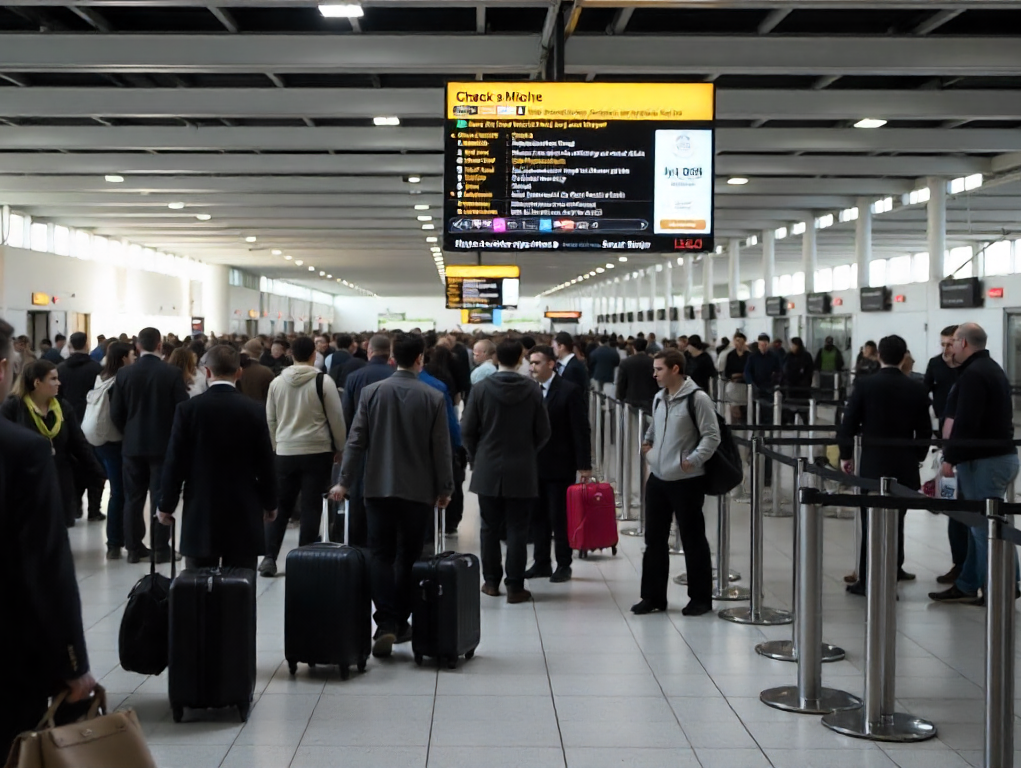
In today’s geopolitical climate, attacks on critical infrastructure are becoming increasingly frequent and sophisticated. On 19th of September 2025, several major European airports – including Heathrow (London), Brussels, and Berlin Brandenburg – were hit by a large-scale cyberattack. The target was MUSE, the passenger check-in and boarding system operated by Collins Aerospace and used by numerous airlines.
The consequences were immediate: passengers stuck in endless queues, flights delayed or canceled, and a heavily disrupted passenger experience. It is important to note, however, that the attack targeted only the IT infrastructure – the software managing passenger and baggage data. Critical safety systems, such as air traffic control, were not affected.
While the impact was serious, the scenario could have been far more severe if the attack had extended to other OT or IoT systems. IT deals with data and applications, whereas OT and IoT control the physical side of airport operations: automated gates, lighting systems, intelligent cameras and sensors, baggage conveyor belts, and even fuel transport systems. In that case, the disruption could have meant a complete shutdown of operations and direct risks to passenger safety.
The risks of lateral movement of a cyberattack from IT to OT and IoT — or from OT and IoT to IT — illustrate the need for comprehensive OT and IoT cybersecurity protection for almost all businesses, not just airports. IoT is almost ubiquitous these days, and OT devices can be found in factories, power companies, water systems, smart cities, smart buildings, retail, transportation, and oil & gas plants, among others.
With OT cyberattacks growing faster than IT attacks — up 53% over last year — and with AI making those attacks smarter and faster, there has never been a more important time to add or upgrade OT and IoT cybersecurity.
The solution provided by iOT365 and CIVITAS addresses precisely this critical area, bringing together advanced capabilities such as:
- Protection for OT and IoT – for airports this includes automated gates, critical sensors, lighting systems, fuel transport systems, smart cameras, and baggage conveyor belts, continuously monitored to prevent major operational disruptions. For other industries this covers SCADA systems, factory PLCs, building management systems, HMIs, POS systems, credit card scanners, and more.
- Asset discovery and mapping – many organizations are not even aware of all the IoT and OT devices connected to their networks, due to their distributed nature and use of many different protocols.
- Early anomaly detection – AI and machine learning help identify unusual network behavior quickly.
- Rapid and coordinated response – automated incident response playbooks enable efficient, structured intervention.
- Distributed or centralized monitoring – whether your site utilizes fully air-gapped networks, hybrid networks, or cloud-connected networks, the platform provides monitoring at the network level, at the site level, or even across multiple sites, while maintaining network isolation where needed.
The recent airport attack highlighted the vulnerabilities of IT systems, but also underscored the urgent need to strengthen protection across OT and IoT. Platforms such as iOT365 provide trusted protection and operational continuity, playing a decisive role in building resilient infrastructure across industries.