Mechanical physical systems
Communication Systems
Electromagnetic Protection
Electronic security systems
Access Control
In recent years, access control systems have become very popular due to their superior record-keeping and increased compliance with organization-imposed rules, ranging from access rights and work schedules to internal flow organization.
Modern systems allow access based on biometric data and have additional alerting and recording functions. Additionally, these systems can generate time logs, thus saving the work time required by other departments of the organization for data input.
These systems greatly enhance the three components of access (validation, control, and recording) and are particularly useful in locations with numerous and diverse flows, locations where a large number of people have access, and where special access conditions need to be ensured.
Access control is a system that authorizes a person’s physical access to a specific space within a given time frame based on information stored in the system’s memory. It compares input data (a code entered from a keyboard, a code stored on a medium such as a magnetic or proximity card, certain biometric data such as fingerprint, facial contour, iris, etc.) with similar data existing in a database.
Biometric solutions, magnetic or proximity cards
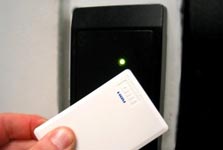 Code-based access control – the identification terminal is a keyboard where a code from 4 to 8 digits is entered for access. The central unit compares the entered code with those stored in the database.
Proximity card-based access control – the identification terminal is a proximity card reader. The information code is stored in an LC circuit (coil-capacitor) inside the proximity card. The card reader emits a field that excites the circuit, allowing the information to be read and compared with the information stored in the database.
Biometric fingerprint-based access control – the identification terminal is a device that reads biometric characteristics (fingerprint, facial recognition, iris recognition, etc.).
X-RAY baggage scanners
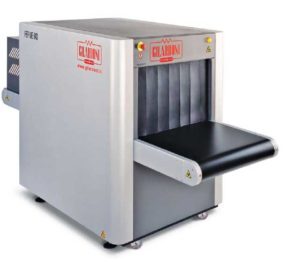 X-ray baggage scanners are intended for equipping control points of institutions of special importance (airports, military units, prisons, sensitive industrial facilities, etc.) and allow non-destructive scanning, using X-rays, of the contents of baggage and parcels, enabling the detection of prohibited materials and substances entering the respective institution. Our company sells, installs, maintains, and services these equipment, being authorized for this purpose by the competent authorities of the Romanian state.
Turnstiles
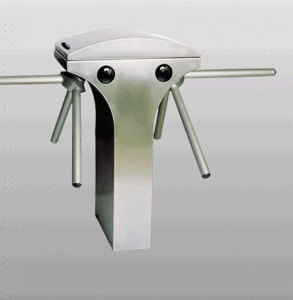 Mechano-electric systems, different in shape and size, allowing restricted access/egress (one by one) of individuals within a perimeter, based on the prior identification of the respective person using specific means (access codes entered, access cards, fingerprints, retinal prints, etc.). Effective access blocking through turnstiles is achieved using steel crossarms, metal grilles, impact-resistant glass panels.
Recommended for: entry into institutions/perimeters where access is restricted based on the identity of the individuals entering/exiting the perimeter.
Barriers, automated gates
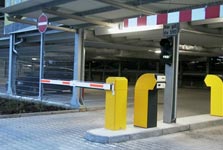 Mechano-electric systems, different in shape and size, allowing restricted access/egress (one by one) of vehicles into/from a perimeter, based on the prior identification of the vehicle or the respective driver using specific means (access codes entered, access cards, cameras with license plate recognition software, etc.). The movement of barrier arms and access gates can be linear in the horizontal plane, rotary in the horizontal plane, rotary in the vertical plane, using mainly solutions with electric motors or (less frequently) linear magnetic motors (for high-speed sliding gates).
Recommended for: entry into non-sensitive institutions/perimeters where access is restricted based on the identity of vehicles or drivers entering/exiting the perimeter.
Anti-terror barriers
 Mechanical systems with hydraulic, pneumatic, electric actuation, different in shape and size, allowing forceful blocking (and consequently severe damage) of a vehicle attempting to force entry and illegally enter/exit the respective perimeter.
Types: retractable barriers, bollards (steel cylinders that can be raised or lowered on command), solid steel arm barriers resistant to impact, spike barriers for tire destruction (less commonly used in sensitive, small-sized perimeters).
The movement of anti-terror barriers can be linear in the horizontal plane, linear in the vertical plane, rotary in the vertical plane, with their operation being parallel to the conventional means of controlling vehicle access (barriers and conventional gates).
Recommended for: entry into sensitive institutions/perimeters (embassies, military units, ministries, refineries, explosives factories, chemical plants, airports, etc.) where access is restricted based on the identity of vehicles or drivers entering/exiting the perimeter.
PARTNERS