Mechanical physical systems
Communication Systems
Electromagnetic Protection
Communication systems
Conference, Simultaneous Translation, and Sound System
Sound systems, conference systems, and translation systems are among the most common communication systems used in office buildings, hotels, or even in factories or industrial parks.
The applicability of such solutions is more about the work environment and how current specific activities are approached rather than the type or format of the objective.
Sound systems, for example, can have other applications related to ambiance or emergency situations, in which case they can be used for public announcements or as means of crowd control.
Videoconferencing
It has the advantage of being a flexible technology, as it allows the connection, in the same session, of various equipment (laptop, notebook, videophone, etc.), as well as integration with peripheral equipment – interactive boards, projection systems, document cameras, sound systems. It is free of interruptions, distortions, elements often encountered during the use of other remote communication software through the Internet.
Simultaneous Translation
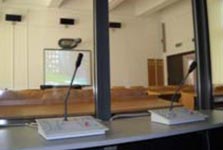 The simultaneous translation system is used for simultaneous translation in 2 (or more) languages during meetings with participants of different nationalities, offering the possibility of professional listening. The signal transmission is done with the help of infrared technology. Participants can freely listen to the desired language, selectable via headphones.
Applications: conference and multimedia halls, congress halls, business centers, councils, city halls, prefectures, universities, faculties, government, ministries, public institutions.
Sound System
An arrangement of microphones, electronic signal processors, amplifiers, and audio enclosures arranged in such a way that live or pre-recorded events (usually music or voice) can be heard louder and at a greater distance. Sound systems contain at least three parts: the input part, such as microphones that convert acoustic energy into electrical energy, signal processors such as equalizers and power amplifiers, and the output part: the speaker, which transforms electrical energy back into acoustic energy and is usually mounted in an audio enclosure to increase its efficiency.
Applications: The systems can be implemented in various locations such as: venues, guesthouses, salons, swimming pools, hospitals, stadiums, airports, etc.
PARTNERS